Olli Böhm – About Images That Don’t Capture the Moment but Carry It Forward
Some works don’t meet you like a statement, but like a mood. Not loud. Not explanatory. Instead, you realize after the first glance:
This image stays – even though it actually speaks of something fleeting. Olli Böhm’s art belongs to this category.
It moves between photography and painterly intervention, between visibility and memory. Its starting points are situations from life:
urban scenes, transitions, people in motion, a glance that lingers in passing. But what emerges is never just a depiction. It is a condensation.
Böhm’s images feel like layers – not because they strive to be complicated, but because they quietly show that every moment holds more
than what meets the eye at first glance.
Photography as Starting Point – and as Material
Olli Böhm works with photography, but he does not use it as an endpoint. For him, the shot is a foundation, a raw material, a first trace.
Through digital editing, overlays, and manual interventions, he develops an image surface that deliberately refuses to be fixed: It remains
pen, breathing, sometimes even resistant. This is precisely where the contemporary quality of his work lies: In a present where images
are often trimmed for maximum clarity and perfection, he allows the image to keep its traces. Not every line has to be “right.”
Not every surface has to be “clean.”
Not every moment has to “resolve.”
Blur and chance are not weaknesses for him, but choices: intimacy instead of distance, truth instead of surface.
The Human as Emotional Logic
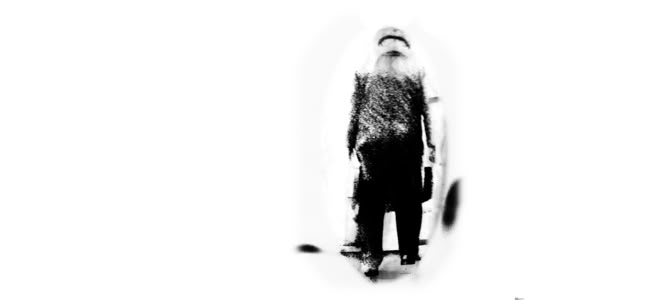
In Böhm’s work, the human figure often takes center stage – but rarely as a classical portrait. Figures appear as presence,
as signs in space, as fragmentary traces. Sometimes it’s just a body walking, a silhouette passing by, a posture that says more
than a face. For him, the human is not a “subject.” It is structure: an inner logic that holds the image together.
These figures don’t explain – they open. They are projection surfaces for experience: being on the move, pausing, distance, closeness.
And that is precisely why these works feel so immediate: You don’t need to “understand” them to be struck by them. You feel them.
Urban Spaces as States
Many of his works are rooted in urban contexts: streets, promenades, passages – places where people cross paths without truly meeting.
But Böhm doesn’t show the city. He shows what it evokes.
Fleeting encounters, loneliness in the current of people, the rhythm of movement – the city as a state.
At this point, his works gain an almost cinematic quality: not because they want to look “cinematic,” but because they feel like stills that carry an entire scene within them.
Melancholy That Isn’t Heavy
A key to understanding Böhm’s work is his treatment of melancholy. It is present in his images – but not as weight, rather as energy. As a fine vibration between the inner and outer world.
The artist describes this approach with a sentence that runs like a quiet guideline through his work:
“My client is the sensitive moment in minor key.”
This is not a pose. It is a method: intuition before plan, experiment before perfection.
Why This Position Matters in the DACH Region
Olli Böhm is part of a field of contemporary artists who see photography not as documentation but as image art – as a starting point
for transformation. His works are neither pure photography nor classical painting. They move in between – and that’s exactly where
their relevance lies: They speak to a present in which images are everywhere, yet rarely resonate.
Böhm’s works don’t linger because they are loud.
They linger because they touch something you cannot immediately name.
And they possess a recognizability that is crucial for collectors: a visual language that runs through different series – a subtle
motif of movement, of “moving on,” of presence in space, that you can rediscover without it ever becoming obvious.